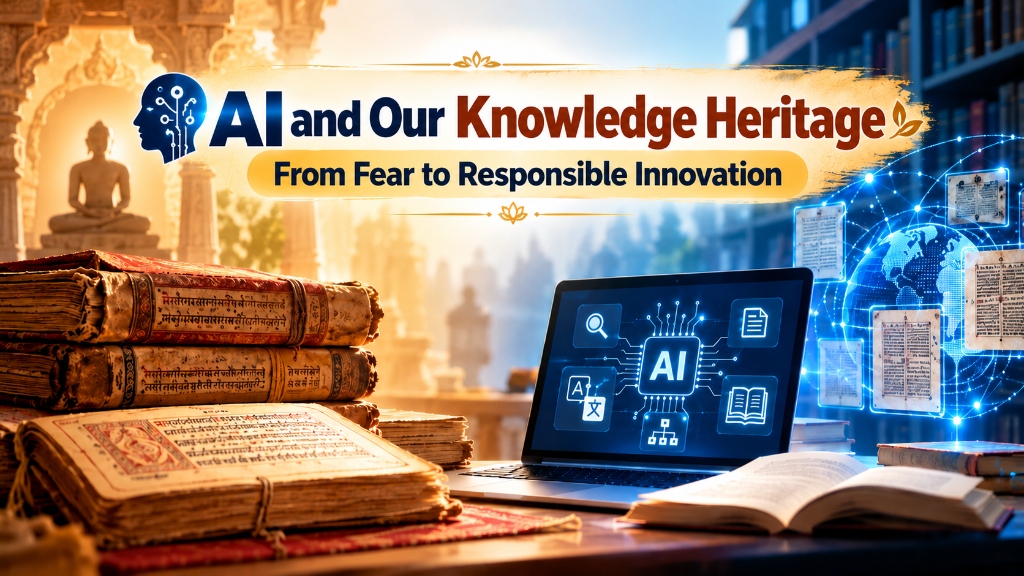
AI and Our Knowledge Heritage: From Fear to Responsible Innovation
Recent discussions surrounding “Project Panama” have raised concerns about the acquisition of books, their destructive scanning to create digital copies, and the subsequent destruction of the physical books. This is certainly concerning, particularly when rare and historically significant knowledge is involved.
However, it is important to understand one thing clearly. According to currently available reports and court documents, the books involved appear to have been sourced primarily from the physical book markets of the United States and Europe. The reports refer to Anthropic purchasing large numbers of books, scanning them to create digital copies, and planning or carrying out the destruction of the physical copies. As of the information currently available, there is no evidence that books from India's Jain Gyan Bhandars have been purchased and destroyed as part of Project Panama.
Therefore, claiming that Project Panama has resulted in the destruction of books from India's Jain Gyan Bhandars would not be justified on the basis of the information currently available. However, that does not mean we have nothing to learn from this incident.
This development certainly raises an important question: If the future creates an enormous demand for rare and inaccessible knowledge resources for AI, how will we protect our ancient knowledge heritage?
The answer is not to distance ourselves from AI. Even today, if ancient books and manuscripts are digitally preserved in a systematic manner without causing any damage to the original physical copies, AI can help us make that knowledge more accessible. It can help us:
- Search for information.
- Explain concepts in different languages.
- Organise content by subject.
- Retrieve relevant references.
- Make knowledge accessible to the next generation.
- Compare content with original texts to help verify its authenticity.
The positive use of AI in this manner is not a vision of the distant future. Even today, several Jain and non-Jain institutions, knowledge repositories, and research organisations are using AI and modern digital technologies to preserve and disseminate knowledge.
AI is being used to scan ancient texts and preserve them digitally, convert them into searchable text through OCR, translate them into different languages, retrieve relevant references from extensive collections of literature, compare the content and cross-references of different texts, prepare summaries, and accelerate research.
What Does True Digital Preservation Mean?
Simply scanning an ancient text or converting it into digital text through OCR does not amount to complete preservation. At least three layers are essential for proper digital preservation:
1. Image Level
High-quality digital images of the original pages must be preserved so that the original text, script, page layout, and other visual details can be examined again in the future.
2. Text Level
The text should be converted into digital form through OCR or transcription with the highest possible level of accuracy. This makes it searchable and useful for research, comparison, and AI applications.
3. Metadata Level
Information such as the title of the text, author, period of composition, edition, location, manuscript details, number of pages, language, script, source, and other bibliographic and provenance details should be recorded. AI can also be useful in this process.
Only when all three layers are preserved with authenticity can digital preservation become truly robust. • Image preserves the original form. • Text/OCR makes knowledge searchable. • Metadata preserves the identity and authenticity of the knowledge.
Therefore, preserving our Jain knowledge heritage requires more than simply putting data into AI. We need to build an authentic, traceable, and securely preserved digital knowledge infrastructure.
Various scholars, pandits, researchers, and dedicated individuals are already contributing to such initiatives and taking this work forward. As a result, tasks that previously required hours or days can now be completed in significantly less time, allowing rare knowledge to reach a wider audience more quickly.
In other words, the same technology can be used to destroy knowledge or to preserve, enrich, and disseminate it. The misuse of AI by an individual or an organisation does not make the entire technology inherently bad. AI is a powerful tool. How we use it is in our hands.
The same AI technology can be used to destroy knowledge, or it can be used to digitise, preserve, search, translate, understand, and transmit an ancient text to the next generation. The question, therefore, is not whether AI is good or bad. The real question is: How are we using AI? Will AI be used to destroy books, or to make their knowledge accessible to more people?
Used wisely, AI can become one of our most powerful tools. We do not need to fear AI. We need to guide it in the right direction.
If It Is a Jain Scripture, the Process Should Be Clear
In this way, AI does not become a replacement for the book. It becomes a pathway to the book.
The Next Generation and Knowledge Revival Through AI
Today, it appears that a large section of the younger generation does not regularly read Jain scriptures. Sometimes, this is due to language barriers; at other times, it is because of a lack of time. However, today's young people are actively seeking answers to many questions. They can ask AI a question. AI can provide an answer, show the source, and encourage them by saying: “For more information, read the original text.”
A question becomes the beginning. A question gives rise to curiosity. Curiosity leads to study. Study keeps knowledge alive. This is Knowledge Revival through AI. Here, AI should not be our master. It should be our servant. 🙏
Establishing an Authoritative Standard for Authentic Jain Knowledge
We need to think one step further and prepare for the future. As our ancient Jain texts become available in digital form, different versions, OCR outputs, translations, and interpretations will appear across websites, databases, AI models, and other digital platforms around the world. This will raise an important question: “Which is the authentic and authoritative version of the text?” To address this, the Jain community must proactively establish an authentic digital source of truth.
Wherever possible, such an authoritative digital record should include:
- Authentic images of the original text
- Verified text
- Reliable metadata
- Source and provenance information
- Edition and manuscript details
- Scholarly verification
- Authoritative references, wherever required
Any AI system, research platform, or digital service working with Jain knowledge should then be able to connect, wherever possible, with these authoritative sources. Our objective should not be limited to simply putting knowledge online. Our objective should be to establish an authoritative, authentic, and traceable digital ecosystem for Jain knowledge. This can also provide an important safeguard against misinformation, incorrect OCR, altered texts, and unintended errors generated by AI.
Michhami Dukkadam if anything written here is contrary to the Jin Agya. 🙏